
Executive summary
Entre Ríos is at a favorable moment for distributed solar generation: a consolidated provincial framework, current national tax incentives and one of the strongest solar resources in Argentina's Litoral region.
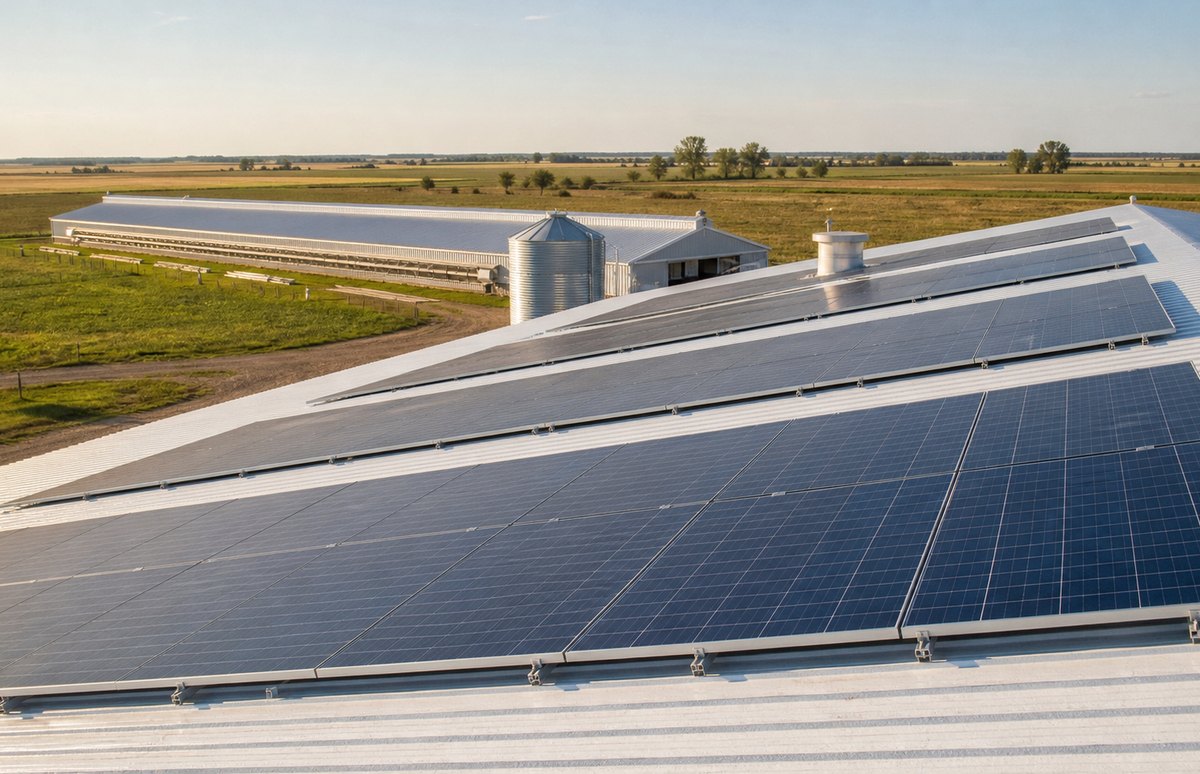
Based on a real audited photovoltaic installation in an Entre Ríos poultry facility, this report builds a territorial extrapolation model applied to poultry roof area surveyed in La Paz, Nogoyá and Colón.
The existing poultry roof area in these three departments totals 238 hectares. Under a conservative use scenario, applying 60% of available roof area as in the reference case, that surface could host approximately 119 MWp of installed solar capacity.
Why this is the right moment
Active regulatory framework
Entre Ríos adhered to Argentina's National Law 27,424 through Provincial Law 10,933, setting a 30% sustainable energy target by 2030 and raising the maximum installable power per user from 50 kW to 1 MW.
Resolution 120/2026 regulated Community and Remote Distributed Generation, enabling several producers to associate under a shared generation scheme. At the national level, RIMI 2026 enables VAT refunds and accelerated depreciation for energy investments.
Good solar resource, stronger in the north
Provincial solar maps show annual solar radiation between 1,550 kWh/m²/year and 1,800 kWh/m²/year in Feliciano and northern Federación, the highest values in the province.
The reference case
The model starts from a broiler poultry facility with continuous operation, annual electricity consumption of 63,563 kWh, 1,200 m² of available roof and an industrial T3 tariff.
| Parameter | Value |
|---|---|
| Installed power | 60 kWp |
| Occupied area | 720 m², equivalent to 60% of available roof |
| Annual consumption coverage | 107.77% |
| Initial investment | USD 39,000 - 42,000 |
| CO₂ emissions avoided | 751 tonnes over 25 years |
Financial result
| Indicator | Own capital | With CFI green financing |
|---|---|---|
| NPV | USD -1,925 | USD 9,503 |
| IRR | 11.3% | 18.3% |
| Simple payback | 9 years | 8 years |
With 100% own capital, the project shows a slightly negative net present value. It becomes positive with soft financing, in this case CFI's green credit line.
Territorial extrapolation
The reference case produces physical and financial parameters that can be applied to poultry shed roof area identified by Landbau through satellite remote sensing in La Paz, Nogoyá and Colón.
| Derived parameter | Value | Base calculation |
|---|---|---|
| Power density | 833 kWp/ha of roof | 60 kWp / 720 m² |
| Installation cost | USD 700/kWp | USD 42,000 / 60 kWp |
| Specific generation | 1,142 kWh/kWp/year | Reference consumption and coverage |
| Avoided emissions | 0.50 tCO₂/kWp/year | 751 tCO₂ / 25 years / 60 kWp |
| Effective roof use | 60% | 720 m² / 1,200 m² available |
District distribution
Poultry roof area is not evenly distributed. In La Paz, Alcaraz 2° concentrates 62% of the department's poultry roof area. In Nogoyá, Algarrobitos concentrates 73%. In Colón, the roof area is more evenly distributed across five districts.
Interactive district map
Real KML geometry. Color intensity indicates hectares of poultry roof area by district; click each area to open the territorial detail.
La Paz · 27.41 ha surveyed
- Alcaraz 2°17.0 ha
- Feliciano, district of La Paz5.4 ha
- Alcaraz 1°3.7 ha
- Yeso1.3 ha
Nogoyá · 42.26 ha surveyed
- Algarrobitos30.8 ha
- Sauce6.7 ha
- Don Cristóbal2.8 ha
- Crucecitas1.3 ha
- Montoya0.7 ha
Colón · 168.61 ha surveyed
- District 1°58.9 ha
- District 2°51.0 ha
- District 3°36.2 ha
- District 4°11.3 ha
- District 6°10.0 ha
Realistic scenario results
| Department | Power | Investment | Generation | CO₂ avoided |
|---|---|---|---|---|
| Colón | 84,302 kWp | USD 59.0 M | 96.3 GWh/year | 42,235 t/year |
| Nogoyá | 21,129 kWp | USD 14.8 M | 24.1 GWh/year | 10,586 t/year |
| La Paz | 13,702 kWp | USD 9.6 M | 15.6 GWh/year | 6,865 t/year |
| Total | 119,133 kWp | USD 83.4 M | 136.1 GWh/year | 59,686 t/year |
Conclusions and recommendations
- The structural opportunity is real: 238 hectares of existing poultry roof area are an underused physical asset for clean energy generation.
- Access to soft financing is the variable that defines viability more than technology or solar resource.
- Community Distributed Generation creates a pathway to scale beyond individual facilities, especially in Colón.
- The provincial solar-resource gradient suggests adding energy criteria to the territorial planning of new productive infrastructure.